Mary Magdalene: From Brokenness to a Bold and Devoted Faith

Like Mary of Bethany, we know the town where Mary Magdalene comes from by how she is identified. She was from the town of Magdala, a city off the coast of Galilee roughly three miles from Capernaum, known for its dye and textile industry. The Bible does not mention her parents, marital status, children, or even her age. We may assume she was unmarried and without children, given her willingness to serve in the years following her encounter with Christ.

Some have believed Mary Magdalene to be either a prostitute or the woman who sat at Jesus’ feet in Luke 7:37. The latter assumption comes because she is introduced just a few verses after that woman. However, Scripture never confirms this. What we are told is that she was possessed by seven devils (demons) (Luke 8:2).

We are first introduced to Mary Magdalene chronologically in Luke 8:1–3:

1 And it came to pass afterward, that he went throughout every city and village, preaching and shewing the glad tidings of the kingdom of God: and the twelve were with him, 2 And certain women, which had been healed of evil spirits and infirmities, Mary called Magdalene, out of whom went seven devils, 3 And Joanna the wife of Chuza Herod’s steward, and Susanna, and many others, which ministered unto him of their substance.”

Notice the number of demons—seven. Seven is a spiritual number of completeness. Mary was completely dominated by these demons. Imagine what she might have looked like as the demons took control of her body, making her physically weak and sickened by their power. Her life must have been one of torment—no rest, no peace of mind or heart—until she met the Savior.

We are not told how or where she met Jesus, nor the specific events of her deliverance. But we do know she had been “healed of evil spirits and infirmities” (Luke 8:2). During her possession, her mind might have been like a stormy sea—chaotic and restless—but after encountering Jesus, she must have experienced a peace as calm as the stillest ocean.

Mary Magdalene was made completely whole. She had a new life and a new purpose. Having been freed by Jesus Christ, she desired to serve Him—the One to whom she owed everything—and to tell others what He had done for her.

She became deeply involved in Jesus’ ministry. Mary Magdalene is mentioned fourteen times in the Gospels. In eight of those passages, she appears in connection with other women, but always listed first—perhaps indicating a leading role in service. Five times she is mentioned alone in connection with the Resurrection (Mark 16:9; John 20:1, 11, 16, 18). Only once is she listed after others (John 19:25). Her repeated mention shows her importance and devotion to Jesus’ ministry.

Her faithfulness and gratitude are striking. Though we may not have been freed from seven demons, Jesus has delivered us from the bondage of sin and its eternal consequences. Do we express the same gratitude and devotion to Him?

When the time came for Jesus to die on the cross for the sins of mankind, many forsook Him. Yet, Mary Magdalene was not one of them. She was there as He was led to Golgotha and crucified. While many of His disciples had fled, she remained near, alongside His mother and others. She watched in sorrow as the One who had healed her was mocked, stripped, beaten beyond recognition, and nailed to a cross. Though powerless to stop the suffering, she stayed—offering her presence and comfort in His final moments.

After His death, Joseph of Arimathaea took Jesus’ body, wrapped it in linen, and laid it in his tomb. Matthew 27:61 says, “And there was Mary Magdalene, and the other Mary, sitting over against the sepulchre.”

Her devotion continued even in His death. She had ministered to Jesus in life, and now she ministered to Him in burial. Luke 23:56 adds, “And they returned, and prepared spices and ointments; and rested the sabbath day according to the commandment.”

Even in grief, she was thoughtful and intentional in her service—planning to return after the Sabbath to anoint His body.

Mary was one of the last to leave the cross and the first to arrive at the tomb. She became the first witness to the most significant event in human history: the resurrection of Jesus Christ. What an honor and privilege!

John 20:1–18 tells the account:

John 20.1-18, “1 The first day of the week cometh Mary Magdalene early, when it was yet dark, unto the sepulchre, and seeth the stone taken away from the sepulchre. Then she runneth, and cometh to Simon Peter, and to the other disciple, whom Jesus loved, and saith unto them, They have taken away the Lord out of the sepulchre, and we know not where they have laid him. Peter therefore went forth, and that other disciple, and came to the sepulchre. So they ran both together: and the other disciple did outrun Peter, and came first to the sepulchre. And he stooping down, and looking in, saw the linen clothes lying; yet went he not in. Then cometh Simon Peter following him, and went into the sepulchre, and seeth the linen clothes lie, And the napkin, that was about his head, not lying with the linen clothes, but wrapped together in a place by itself. Then went in also that other disciple, which came first to the sepulchre, and he saw, and believed. For as yet they knew not the scripture, that he must rise again from the dead. 10 Then the disciples went away again unto their own home. 11 But Mary stood without at the sepulchre weeping: and as she wept, she stooped down, and looked into the sepulchre, 12 And seeth two angels in white sitting, the one at the head, and the other at the feet, where the body of Jesus had lain. 13 And they say unto her, Woman, why weepest thou? She saith unto them, Because they have taken away my Lord, and I know not where they have laid him. 14 And when she had thus said, she turned herself back, and saw Jesus standing, and knew not that it was Jesus. 15 Jesus saith unto her, Woman, why weepest thou? whom seekest thou? She, supposing him to be the gardener, saith unto him, Sir, if thou have borne him hence, tell me where thou hast laid him, and I will take him away. 16 Jesus saith unto her, Mary. She turned herself, and saith unto him, Rabboni; which is to say, Master. 17 Jesus saith unto her, Touch me not; for I am not yet ascended to my Father: but go to my brethren, and say unto them, I ascend unto my Father, and your Father; and to my God, and your God. 18 Mary Magdalene came and told the disciples that she had seen the Lord, and that he had spoken these things unto her.

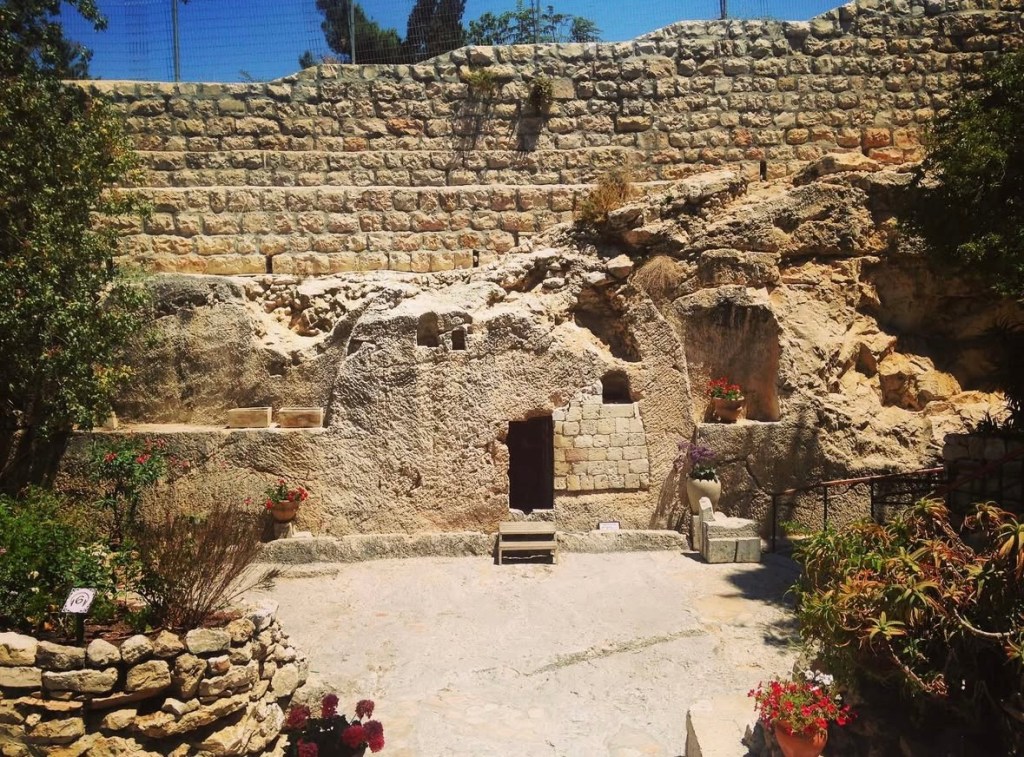
The Garden Tomb – Jerusalem, Israel

Mary came to the tomb early that first Easter morning, while it was still dark. Seeing the stone rolled away, she wept in confusion and grief. She ran to Peter and John, exclaiming, “They have taken away the Lord out of the sepulchre, and we know not where they have laid him.”

The disciples ran to the tomb, saw it empty, and departed—“to their own home.” But not Mary. She stayed. Standing outside, weeping, she looked in and saw two angels sitting where Jesus’ body had been. They asked, “Woman, why weepest thou?” She replied, “Because they have taken away my Lord, and I know not where they have laid him.”

Turning around, she saw a man she thought was the gardener. When He asked, “Woman, why weepest thou? whom seekest thou?” she replied, “Sir, if thou have borne him hence, tell me where thou hast laid him, and I will take him away.”

Her love and devotion blinded her to the impossibility of her own words—how could she carry a man’s body alone? But her concern was not for herself; her heart was full of Christ. Then Jesus spoke her name: “Mary.” Instantly she recognized His voice and cried, Rabboni!—meaning Master. As I read that Scripture, I can’t help but choke up. Even now, I feel as though I cannot fully comprehend the emotions she must have felt in that moment. Not knowing when she would hear His voice again. The One who had once called her out of the depths of her sin—the One whose death on the cross for her she had witnessed—had conquered death and now stood alive before her.

In that moment, the weeping woman became the first witness of the risen Savior. Jesus then commissioned her with the greatest message ever given:

“Go to my brethren, and say unto them, I ascend unto my Father, and your Father; and to my God, and your God.”

Mary ran with joy to tell the disciples that Jesus was alive.

Though this is the last direct mention of Mary Magdalene in Scripture, we can reasonably assume she was probably among the women in Acts 1:14, who prayed and waited with the apostles for the coming of the Holy Spirit. On the day of Pentecost, she would have been filled with His power and continued as a faithful witness of her risen Lord.

There are several lessons we can learn from Mary of Magdala.

First, she shows what Christ can do for a woman—or for anyone. When Jesus met her, she was tormented and enslaved in sin, but He healed her completely—body, mind, and soul—and made her one of His loyal followers. Likewise, if we have been saved, we too have been cleansed and set free from sin through Him.

Second, Mary’s life shows what a grateful believer can do for the One who has done so much. Once healed, she served. She followed Jesus, ministered to His needs, and testified of His death and resurrection. Her gratitude overflowed into devotion.

Mary owed much, gave much, loved much, and served much. May we, like Mary Magdalene, love and serve Christ to the fullest, daily witnessing to the power of His resurrection.

Some questions for reflection: 

  1. Imagine the contrast between Mary’s life before and after meeting Jesus. What might her peace and freedom have felt like?
  2. What does Mary’s presence at the cross and the tomb reveal about her love and courage?
  3. Jesus sent Mary to deliver the first message of His resurrection. What does this tell us about how God values and uses women in ministry?
  4. Mary’s gratitude overflowed into action. What are some ways we can express gratitude to God beyond words?

Living Out God’s Purpose: Mary’s Submission Leads to God’s Plan

Read Luke 1.26-56

What is your purpose? Has that question ever crossed your mind? The dictionary defines purpose as “the reason for which something is done or created or for which something exists.” But when you think about your life, what gives it meaning?

Many of us spend a lot of time thinking about what we should be doing—what job we should have, who we should marry, what we should study, or how we can best serve. But often, we still feel uncertain. We wonder, “Am I in the right place? Am I fulfilling my true purpose?” Sometimes, it’s easy to get caught up in external achievements, whether it’s our career, relationships, or even our physical appearance, as if those things define our purpose.

As Christians, however, our true purpose is not found in any of these things. Our purpose is found in our relationship with Jesus Christ. Through Him, we are connected to God the Father, our Creator, who made us with intention and purpose.

Psalm 138:8 says, The LORD will perfect that which concerneth me; thy mercy, O LORD, endureth forever: forsake not the works of thine own hands. This is a beautiful reminder that it is God who fulfills His purpose for us. Our purpose doesn’t depend on our career, our relationships, our education, or even our circumstances. These things are part of our lives, but they don’t define who we are or why we exist. Everything we have is a gift from God, and He can use all these things to bring glory to Himself. He is the one ordering our steps and leading us exactly where we need to be.

When we trust that God is fulfilling His purpose for us, we can let go of anxiety. We don’t need to worry about whether we’ve chosen the right job, or if we’re in the right ministry, or even if we’ve made the right life decisions. Romans 8:28 reminds us that, all things work together for good to them that love God, to them who are the called according to His purpose. Even when things feel uncertain, God is at work. He is guiding us and leading us into His will, no matter how unclear the path might seem.

There will be times when trusting God feels harder than others. On some days, it will be easier to rest in His love and purpose for us. On other days, it may seem like our lives are spinning out of control. But remember, John 15:9-11 reminds us of this promise: 9 As the Father hath loved me, so have I loved you: continue ye in my love. 10 If ye keep my commandments, ye shall abide in my love; even as I have kept my Father’s commandments, and abide in His love. 11 These things have I spoken unto you, that my joy might remain in you, and that your joy might be full.

We don’t have to be stressed about finding our purpose or feeling like we’ve missed something. It all begins with knowing who we belong to. Our purpose is to live in relationship with God, to trust Him to fulfill His plan for our lives and ultimately submit to Him alone. When we feel lost or uncertain, we can take comfort in knowing that He is with us every step of the way. He will never leave us, and He is always working for our good.

True joy comes from abiding in Christ’s love, not from what we do or achieve. Our jobs, relationships, and accomplishments may bring temporary satisfaction, but only Jesus can give us lasting peace and fulfillment. Our purpose begins and ends in Him.

So, what can we do? We can start by prioritizing time with God. Spend time in prayer, seek wisdom from people who encourage you in the faith, and hold fast to the truth of God’s Word. Let’s stop worrying about whether we’re in the “right” job or the “right” season of life. God is in control. Everything will fall into place according to His perfect plan.

Even though we may not understand everything about God or His plans for us, we can trust that He knows us intimately. Psalm 139:23 says, Search me, O God, and know my heart: try me, and know my thoughts. God knows us better than we know ourselves. He knows our dreams, our fears, our passions, and even our future. Let’s open our hearts to Him and allow Him to lead us.

As we move through this year, each of us will walk our own unique journey. We each have different purposes, but the one constant is our relationship with God. Don’t let the world’s standards of success distract you. Romans 12:2 urges us, And be not conformed to this world: but be ye transformed by the renewing of your mind, that ye may prove what is that good, and acceptable, and perfect will of God. Our purpose is not defined by the world’s expectations but by God’s will.

As we set new goals for the year, let’s remember that our purpose is not tied to external achievements but to our relationship with Jesus. Let Him be the reason we are excited about the future. He is the reason we can have peace, knowing that He is in control and that our lives are in His hands.

This time of year is often reflective and thoughtful for many reasons. As we look forward to Christmas and the end of the year in the coming weeks, let’s focus on Him. Whether we reflect on the past year or look forward to the year ahead, let us look to Mary as the example of a purposeful life in submission to God’s Will for our lives. 

Lets read Luke 1.26-56

26 And in the sixth month the angel Gabriel was sent from God unto a city of Galilee, named Nazareth,

27 To a virgin espoused to a man whose name was Joseph, of the house of David; and the virgin’s name was Mary.

28 And the angel came in unto her, and said, Hail, thou that art highly favoured, the Lord is with thee: blessed art thou among women.

29 And when she saw him, she was troubled at his saying, and cast in her mind what manner of salutation this should be.

30 And the angel said unto her, Fear not, Mary: for thou hast found favour with God.

31 And, behold, thou shalt conceive in thy womb, and bring forth a son, and shalt call his name Jesus.

32 He shall be great, and shall be called the Son of the Highest: and the Lord God shall give unto him the throne of his father David:

33 And he shall reign over the house of Jacob for ever; and of his kingdom there shall be no end.

34 Then said Mary unto the angel, How shall this be, seeing I know not a man?

35 And the angel answered and said unto her, The Holy Ghost shall come upon thee, and the power of the Highest shall overshadow thee: therefore also that holy thing which shall be born of thee shall be called the Son of God.

36 And, behold, thy cousin Elisabeth, she hath also conceived a son in her old age: and this is the sixth month with her, who was called barren.

37 For with God nothing shall be impossible.

38 And Mary said, Behold the handmaid of the Lord; be it unto me according to thy word. And the angel departed from her.

39 And Mary arose in those days, and went into the hill country with haste, into a city of Juda;

40 And entered into the house of Zacharias, and saluted Elisabeth.

41 And it came to pass, that, when Elisabeth heard the salutation of Mary, the babe leaped in her womb; and Elisabeth was filled with the Holy Ghost:

42 And she spake out with a loud voice, and said, Blessed art thou among women, and blessed is the fruit of thy womb.

43 And whence is this to me, that the mother of my Lord should come to me?

44 For, lo, as soon as the voice of thy salutation sounded in mine ears, the babe leaped in my womb for joy.

45 And blessed is she that believed: for there shall be a performance of those things which were told her from the Lord.

46 And Mary said, My soul doth magnify the Lord,

47 And my spirit hath rejoiced in God my Saviour.

48 For he hath regarded the low estate of his handmaiden: for, behold, from henceforth all generations shall call me blessed.

49 For he that is mighty hath done to me great things; and holy is his name.

50 And his mercy is on them that fear him from generation to generation.

51 He hath shewed strength with his arm; he hath scattered the proud in the imagination of their hearts.

52 He hath put down the mighty from their seats, and exalted them of low degree.

53 He hath filled the hungry with good things; and the rich he hath sent empty away.

54 He hath helped his servant Israel, in remembrance of his mercy;

55 As he spake to our fathers, to Abraham, and to his seed for ever.

56 And Mary abode with her about three months, and returned to her own house.

Look at the Angel Gabriel’s announcement in verse 28, Hail, thou that art highly favoured, the Lord is with thee: blessed art thou among women. And then verse 30, And the angel said unto her, Fear not, Mary: for thou hast found favour with God. Think about what kind of woman Mary must have been to have been “highly favoured” and “found favor with God”? What a life a service to God she must have led until she was told by God what her purpose would be? This moment in Mary’s life not only foreshadows key Christian teachings but also serves as a powerful inspiration for believers to embrace God’s plan for their lives. Mary had no way of knowing what God had in store for her, no doubt she knew that she would be mocked and shunned for the pregnancy while she was unmarried to Joseph. Joseph and Mary were in the process of getting married, but not married yet. A unwed pregnancy in ancient culture would have been scandalous and shameful. Mary (and Joseph) would have borne the brunt of the judgment and ridicule for years to come and would no doubt be considered outcasts in certain circles. However, Mary willingly submitted to God’s plan, long before it was revealed through the Angel Gabriel, and God would give her the grace to bare whatever was coming. 

Notice Mary’s response to the Angel Gabriel in verse 38 of Luke 1, And Mary said, Behold the handmaid of the Lord; be it unto me according to thy word. And the angel departed from her. She identified herself as the handmaid of the Lord, a servant of the Lord, ready to do and take on all that would come, not only in the preceding months of pregnancy, but in the years that would follow Jesus birth. She doesn’t really question or ask for God to choose someone else. The only thing she questions is how she was to become pregnant, How shall this be, seeing I know not a man? Mary’s attitude and heart exemplifies humility, faith, and a profound acceptance of God’s will. Her words reflect a readiness to be molded by God’s word and a deep trust in His goodness and sovereignty. Mary’s example serves as a powerful model of how faith responds to God’s call and how one can humbly submit to His will. Some view her response as a reminder of the attitude we should adopt—one that says, “Whatever You (God) desire for my life, that is what I desire too.” Can we say that about ourselves? Mary’s life was one of faithful service to God, even though she couldn’t foresee where that service would ultimately lead. Despite the uncertainty, she remained steadfast in doing what was right and following God’s guidance. 

Let us be Christians that strive to submit to God’s Will in our lives no matter what and follow the course that He has planned for us no matter the changes that come to the plans that we make ourselves. Her life was one of faithful service to God, even though she couldn’t foresee where that service would ultimately lead. Despite the uncertainty, she remained steadfast in doing what was right and following God’s guidance. Our purpose isn’t found in what the world has to offer but in the One who made us and called us to Himself. So as we reflect on the year that is closing and look forward to the year that is coming, let’s commit not to goals and resolutions, but to trust Him and submit to Him in all things, to guide us and fulfill His purpose in our lives. Let Romans 8.28 be a verse that we hold on to in the coming year and beyond, And we know that all things work together for good to them that love God, to them who are the called according to his purpose.

Merry Christmas and a Happy New Year to my Jael’s Journal readers!