
Anna – Faithful to the End

Photo by u674e u4ebfu946b on Pexels.com

Luke 2.36–38 KJV

36 And there was one Anna, a prophetess, the daughter of Phanuel, of the tribe of Aser: she was of a great age, and had lived with an husband seven years from her virginity; 37 and she was a widow of about fourscore and four years, which departed not from the temple, but served God with fastings and prayers night and day. 38 And she coming in that instant gave thanks likewise unto the Lord, and spake of him to all them that looked for redemption in Jerusalem.

Anna’s Background and Faith

Anna was from the tribe of Asher—one of the “lost tribes” of the northern kingdom of Israel who had fallen into idolatry. Yet, by God’s grace, she remained a believing woman of the scattered remnant who still hoped for the Messiah.

She was the daughter of Phanuel, a name meaning “Face of God”—a fitting and providential detail in the events that would unfold in her life. Anna’s own name, the same as Hannah in the Old Testament, means “favor” or “grace.” Like Hannah, Anna was a woman of prayer and devotion, often found in the Temple seeking God’s presence.

Anna’s husband died only seven years into their marriage, leaving her a widow for eighty-four years. By the time she appears in the Gospel of Luke, she was over one hundred years old. In her day, widowhood brought immense hardship. Without a husband, life was uncertain and often lonely. There is no mention of children or family to care for her, yet we are told so much about her character just in the three verses that only speak of her in the entire Bible.

What stands out to me most about Anna is what Scripture does not say—there is no mention of bitterness or self-pity. Instead, we see a woman who met her sorrow with grace, strength, and unwavering faith in the God she had heard of all her life.

Five Lessons from Anna’s Life

Luke’s brief description of Anna reveals five defining qualities that make her an example for every believer:

  1. She was a prophetess.
  2. She departed not from the Temple.
  3. She served God with fastings and prayers night and day.
  4. She gave thanks unto the Lord.
  5. She spoke of Him to all who looked for redemption in Jerusalem.

Let’s look at each of these traits more closely.

1. She Was a Prophetess

Anna was one of the few women in Scripture called a prophetess. Other examples include Miriam, Deborah, Huldah, and Isaiah’s wife in the Old Testament, and Philip’s four daughters in the New Testament.

But Anna was not like Moses, Elijah, Isaiah, Daniel, Jeremiah, Haggai or Ezekiel—prophets who received direct revelation from God. The word prophetess used in describing Anna likely means that she was devoted to speaking and teaching God’s Word, perhaps to other women in the Temple. She may have been a source of encouragement, instruction, and spiritual insight, known for her wisdom and faithfulness.

When Luke calls her a “prophetess,” it doesn’t suggest she held a formal office of prophecy. Rather, she was a woman who deeply knew Scripture and spoke it faithfully—a teacher, encourager, and woman of the Word who had hidden God’s truth in her heart.

2. She Departed Not from the Temple

Anna was a constant presence in the Temple. Perhaps she lived nearby, arriving early each morning and staying until nightfall. Her faithfulness and consistency made her a familiar face to those who worshipped there.

Because of her devotion, Anna was present for the most significant moment of her life—seeing the long-awaited Messiah. Luke notes that she arrived “in that instant,” just as Simeon was blessing the baby Jesus. Her presence wasn’t coincidence; it was the fruit of a lifetime of faithful worship.

If she had stayed home that day, she would have missed the moment she had prayed for her entire life. Anna’s story reminds us that when we are faithful in worship—even when it feels routine—God often meets us in unexpected ways. God saw her faithfulness in the years leading up to that day, and He honored her with one of the greatest gifts of her lifetime. What seemed like a normal morning to Anna was anything but ordinary in God’s plan. Her routine visit to the Temple became the day she met the Savior face to face.

Anna is an example who challenges us: How many opportunities or blessings might we miss if we are not where we should be—faithfully serving God— if we allow lesser things to keep us from worshipping God? but instead allow other things to take priority?

3. She Served God with Fastings and Prayers Night and Day

Anna’s devotion was marked by prayer and fasting. Her fasting was not a ritual or formality, but an expression of deep sincerity and dependence on God. True fasting flows from a heart so consumed with prayer that physical hunger fades in comparison to spiritual desire.

We can only imagine what her prayers over the years were like. Prayers for herself, for others whose paths she crossed, for the nation of Israel, for the coming of the Messiah, for God’s mercy and restoration. She believed with all her heart the promises of the Scriptures. Her faith was rooted in confident expectation of what and who would come, and her life reflected it.

And then one day, the answer to all her prayers came—a tiny baby boy, wrapped in a blanket held in Simeon’s arms. Everything she had longed for was fulfilled before her very eyes.

4. She Gave Thanks unto the Lord

When Anna saw Jesus, she knew in her heart who He was. What overwhelming feelings must she have felt in that moment. She immediately gave thanks to God. Decades of prayer and fasting turned to overflowing praise. Imagine the joy of seeing, in living form, the answer to a lifetime of prayer.

Anna’s gratitude challenges us to trust God’s timing. Sometimes His answers come after years—perhaps even a lifetime—of faithful devotion. But when they come, they are worth every moment of waiting.

5. She Spoke of Him to All Who Looked for Redemption

Anna didn’t keep the good news to herself. She told everyone she met who was waiting for the redemption of Jerusalem. Her age, gender, or social position didn’t stop her from sharing the message of hope.

Like Anna, we too are called to proclaim Jesus and His Good News—the Savior who was born, died, and rose again for our salvation. Let her boldness inspire us not to shrink back in fear or hesitation, but to share the good news freely and joyfully.

Living Like Anna

Anna’s life is a portrait of steadfast faith. She endured great loss throughout her life, yet never wavered in her devotion to God. She prayed when others might have given up. She showed up when others might have stayed home. She could have let circumstances keep her from serving—responsibilities at work or home, weariness, discouragement, or the sometimes heaviness life. Yet Anna persevered. She continued to serve God despite whatever challenges she carried with her.

Let us strive to be like Anna—faithful in worship despite circumstances, steadfast in prayer, and quick to give thanks. Anna had no idea of knowing when or even if her prayers and hearts longings would ever be granted by God, but that never deterred her from her faithful obedience to God.


May we be women (and men) who:

  • Run to God in hardship and difficult times, not away from Him.
  • Remain faithful in service and worship.
  • Stay devoted to prayer, Scripture, and fasting.
  • Tell others about the hope we have in Christ.

Anna’s story reminds us that a life of quiet, consistent faith can leave a powerful legacy—one that points others to Jesus, the Savior and Redeemer of all.
Mary Magdalene: From Brokenness to a Bold and Devoted Faith

Like Mary of Bethany, we know the town where Mary Magdalene comes from by how she is identified. She was from the town of Magdala, a city off the coast of Galilee roughly three miles from Capernaum, known for its dye and textile industry. The Bible does not mention her parents, marital status, children, or even her age. We may assume she was unmarried and without children, given her willingness to serve in the years following her encounter with Christ.

Some have believed Mary Magdalene to be either a prostitute or the woman who sat at Jesus’ feet in Luke 7:37. The latter assumption comes because she is introduced just a few verses after that woman. However, Scripture never confirms this. What we are told is that she was possessed by seven devils (demons) (Luke 8:2).

We are first introduced to Mary Magdalene chronologically in Luke 8:1–3:

“1 And it came to pass afterward, that he went throughout every city and village, preaching and shewing the glad tidings of the kingdom of God: and the twelve were with him, 2 And certain women, which had been healed of evil spirits and infirmities, Mary called Magdalene, out of whom went seven devils, 3 And Joanna the wife of Chuza Herod’s steward, and Susanna, and many others, which ministered unto him of their substance.”

Notice the number of demons—seven. Seven is a spiritual number of completeness. Mary was completely dominated by these demons. Imagine what she might have looked like as the demons took control of her body, making her physically weak and sickened by their power. Her life must have been one of torment—no rest, no peace of mind or heart—until she met the Savior.

We are not told how or where she met Jesus, nor the specific events of her deliverance. But we do know she had been “healed of evil spirits and infirmities” (Luke 8:2). During her possession, her mind might have been like a stormy sea—chaotic and restless—but after encountering Jesus, she must have experienced a peace as calm as the stillest ocean.

Mary Magdalene was made completely whole. She had a new life and a new purpose. Having been freed by Jesus Christ, she desired to serve Him—the One to whom she owed everything—and to tell others what He had done for her.

She became deeply involved in Jesus’ ministry. Mary Magdalene is mentioned fourteen times in the Gospels. In eight of those passages, she appears in connection with other women, but always listed first—perhaps indicating a leading role in service. Five times she is mentioned alone in connection with the Resurrection (Mark 16:9; John 20:1, 11, 16, 18). Only once is she listed after others (John 19:25). Her repeated mention shows her importance and devotion to Jesus’ ministry.

Her faithfulness and gratitude are striking. Though we may not have been freed from seven demons, Jesus has delivered us from the bondage of sin and its eternal consequences. Do we express the same gratitude and devotion to Him?

When the time came for Jesus to die on the cross for the sins of mankind, many forsook Him. Yet, Mary Magdalene was not one of them. She was there as He was led to Golgotha and crucified. While many of His disciples had fled, she remained near, alongside His mother and others. She watched in sorrow as the One who had healed her was mocked, stripped, beaten beyond recognition, and nailed to a cross. Though powerless to stop the suffering, she stayed—offering her presence and comfort in His final moments.

After His death, Joseph of Arimathaea took Jesus’ body, wrapped it in linen, and laid it in his tomb. Matthew 27:61 says, “And there was Mary Magdalene, and the other Mary, sitting over against the sepulchre.”

Her devotion continued even in His death. She had ministered to Jesus in life, and now she ministered to Him in burial. Luke 23:56 adds, “And they returned, and prepared spices and ointments; and rested the sabbath day according to the commandment.”

Even in grief, she was thoughtful and intentional in her service—planning to return after the Sabbath to anoint His body.

Mary was one of the last to leave the cross and the first to arrive at the tomb. She became the first witness to the most significant event in human history: the resurrection of Jesus Christ. What an honor and privilege!

John 20:1–18 tells the account:

John 20.1-18, “1 The first day of the week cometh Mary Magdalene early, when it was yet dark, unto the sepulchre, and seeth the stone taken away from the sepulchre. 2 Then she runneth, and cometh to Simon Peter, and to the other disciple, whom Jesus loved, and saith unto them, They have taken away the Lord out of the sepulchre, and we know not where they have laid him. 3 Peter therefore went forth, and that other disciple, and came to the sepulchre. 4 So they ran both together: and the other disciple did outrun Peter, and came first to the sepulchre. 5 And he stooping down, and looking in, saw the linen clothes lying; yet went he not in. 6 Then cometh Simon Peter following him, and went into the sepulchre, and seeth the linen clothes lie, 7 And the napkin, that was about his head, not lying with the linen clothes, but wrapped together in a place by itself. 8 Then went in also that other disciple, which came first to the sepulchre, and he saw, and believed. 9 For as yet they knew not the scripture, that he must rise again from the dead. 10 Then the disciples went away again unto their own home. 11 But Mary stood without at the sepulchre weeping: and as she wept, she stooped down, and looked into the sepulchre, 12 And seeth two angels in white sitting, the one at the head, and the other at the feet, where the body of Jesus had lain. 13 And they say unto her, Woman, why weepest thou? She saith unto them, Because they have taken away my Lord, and I know not where they have laid him. 14 And when she had thus said, she turned herself back, and saw Jesus standing, and knew not that it was Jesus. 15 Jesus saith unto her, Woman, why weepest thou? whom seekest thou? She, supposing him to be the gardener, saith unto him, Sir, if thou have borne him hence, tell me where thou hast laid him, and I will take him away. 16 Jesus saith unto her, Mary. She turned herself, and saith unto him, Rabboni; which is to say, Master. 17 Jesus saith unto her, Touch me not; for I am not yet ascended to my Father: but go to my brethren, and say unto them, I ascend unto my Father, and your Father; and to my God, and your God. 18 Mary Magdalene came and told the disciples that she had seen the Lord, and that he had spoken these things unto her.“

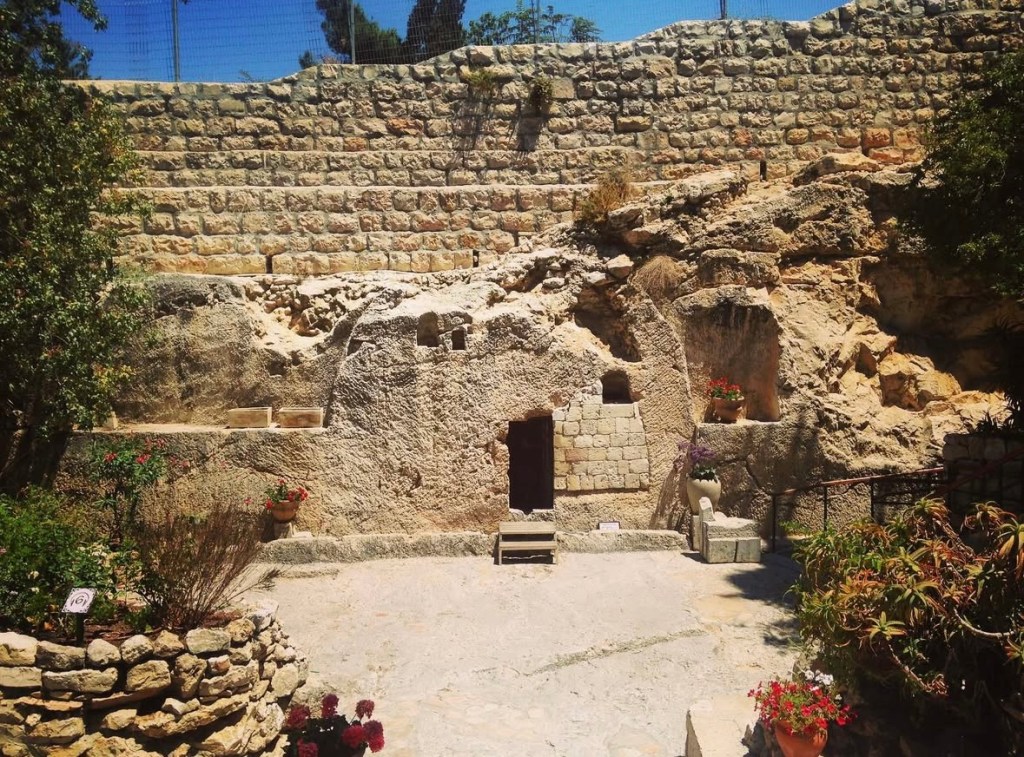
The Garden Tomb – Jerusalem, Israel

Mary came to the tomb early that first Easter morning, while it was still dark. Seeing the stone rolled away, she wept in confusion and grief. She ran to Peter and John, exclaiming, “They have taken away the Lord out of the sepulchre, and we know not where they have laid him.”

The disciples ran to the tomb, saw it empty, and departed—“to their own home.” But not Mary. She stayed. Standing outside, weeping, she looked in and saw two angels sitting where Jesus’ body had been. They asked, “Woman, why weepest thou?” She replied, “Because they have taken away my Lord, and I know not where they have laid him.”

Turning around, she saw a man she thought was the gardener. When He asked, “Woman, why weepest thou? whom seekest thou?” she replied, “Sir, if thou have borne him hence, tell me where thou hast laid him, and I will take him away.”

Her love and devotion blinded her to the impossibility of her own words—how could she carry a man’s body alone? But her concern was not for herself; her heart was full of Christ. Then Jesus spoke her name: “Mary.” Instantly she recognized His voice and cried, “Rabboni!”—meaning Master. As I read that Scripture, I can’t help but choke up. Even now, I feel as though I cannot fully comprehend the emotions she must have felt in that moment. Not knowing when she would hear His voice again. The One who had once called her out of the depths of her sin—the One whose death on the cross for her she had witnessed—had conquered death and now stood alive before her.

In that moment, the weeping woman became the first witness of the risen Savior. Jesus then commissioned her with the greatest message ever given:

“Go to my brethren, and say unto them, I ascend unto my Father, and your Father; and to my God, and your God.”

Mary ran with joy to tell the disciples that Jesus was alive.

Though this is the last direct mention of Mary Magdalene in Scripture, we can reasonably assume she was probably among the women in Acts 1:14, who prayed and waited with the apostles for the coming of the Holy Spirit. On the day of Pentecost, she would have been filled with His power and continued as a faithful witness of her risen Lord.

There are several lessons we can learn from Mary of Magdala.

First, she shows what Christ can do for a woman—or for anyone. When Jesus met her, she was tormented and enslaved in sin, but He healed her completely—body, mind, and soul—and made her one of His loyal followers. Likewise, if we have been saved, we too have been cleansed and set free from sin through Him.

Second, Mary’s life shows what a grateful believer can do for the One who has done so much. Once healed, she served. She followed Jesus, ministered to His needs, and testified of His death and resurrection. Her gratitude overflowed into devotion.

Mary owed much, gave much, loved much, and served much. May we, like Mary Magdalene, love and serve Christ to the fullest, daily witnessing to the power of His resurrection.

Some questions for reflection: 

  1. Imagine the contrast between Mary’s life before and after meeting Jesus. What might her peace and freedom have felt like?
  2. What does Mary’s presence at the cross and the tomb reveal about her love and courage?
  3. Jesus sent Mary to deliver the first message of His resurrection. What does this tell us about how God values and uses women in ministry?
  4. Mary’s gratitude overflowed into action. What are some ways we can express gratitude to God beyond words?