For Scriptural background, read Judges 4 and 5
Judges 4:1-5
1 And the children of Israel again did evil in the sight of the Lord, when Ehud was dead. 2 And the Lord sold them into the hand of Jabin king of Canaan, that reigned in Hazor; the captain of whose host was Sisera, which dwelt in Harosheth of the Gentiles. 3 And the children of Israel cried unto the Lord: for he had nine hundred chariots of iron; and twenty years he mightily oppressed the children of Israel. 4 And Deborah, a prophetess, the wife of Lapidoth, she judged Israel at that time. 5 And she dwelt under the palm tree of Deborah between Ramah and Bethel in mount Ephraim: and the children of Israel came up to her for judgment.
The Covenant and Israel’s Cycle of Rebellion
God entered into a covenant with the Israelites at Mount Sinai, which was conditional upon their obedience. If they obeyed, they would receive blessings, but if they disobeyed, they would face correction – which often in the form of oppression by their enemies. In Judges 4, we see Israel falling into this destructive cycle once again. The time would have been around 1250 B.C., in the Jezreel Valley between the Mediterranean Sea and the Sea of Galilee. The Israelites were reaping the consequences of their disobedience when God allowed them to fall under the rule of King Jabin of Canaan, whose ruthless army was led by the harsh commander Sisera.
For twenty years, the Israelites were oppressed by Sisera’s military might, including his 900 iron chariots, until, in their suffering, they cried out to God for deliverance. Just as God had been faithful to correct His people, He was equally faithful to show mercy. When the Israelites turned back to Him, He answered their prayers. This time would be no different.
Deborah: A Prophetess and Judge
The answer to their prayers came through Deborah, whom God chose to be the fourth of Israel’s 16 judges. Deborah was one of the 16 judges of Israel who were leaders which were specially appointed by God to lead His people. They were tasked with enforcing the covenant and ensuring peace in the land. Deborah stood out not only as a judge but also as one of the nine women in Scripture recognized as prophetesses, such as Miriam and Anna.
Deborah’s name means “bee,” and her name would hold meaning as she would play a crucial role in Israel’s history as described in Judges 4-5 and under her leadership would deliver a stinging blow to Israel’s enemy. Through Scripture, we learn that she was married to Lapidoth, though we do not know whether she had children, and lived in the mountainous region of Ephraim. I wonder what their home life was like? I wonder what kind of relationship they had as husband and wife? I imagine that Deborah, even though she had a strong personality, knew boundaries and her role as a wife. While not much is known about her past or qualifications for leadership, one thing was clear: God called her, and she responded in obedience. Her obedience was rare for that time, especially in a culture where male leadership was the norm.
Deborah held her court, as a judge, outside the city, between Bethel (which means “house of God”) and Ramah (meaning “height”), a region known for its elevated landscape. The place where she held court—under the “Palm Tree of Deborah”—was possibly named after Rebekah’s nurse, who was buried nearby (Genesis 35:8). Her role as a judge was different from the judicial system we think of today. As mentioned previously, a judge in ancient Israel was someone appointed by God to restore the people to Him, often guiding them in battle to defeat their enemies. As a judge, Deborah was deeply concerned for the well-being of those she led, consistently striving to uphold justice. Her decisions were grounded in God’s principles of fairness, and she worked to restore peace and stability to Israel, ensuring that righteousness prevailed in the land.
Deborah’s Court and Leadership
Unlike other judges and prophets, Deborah held court outside the city walls. The city gates were typically where important matters were handled, but Deborah chose to settle disputes and guide the people away from the city, perhaps because of Israel’s sin and idolatry within the city walls. Deborah did not go to the people—rather, they came to her for judgment. This shows that she was a woman of wisdom and respect, someone whose counsel was sought out, and her leadership was honored.
When the time came to lead the Israelites in battle against the Canaanites, Deborah called upon Barak, a military leader from Kedeshnaphtali, whom God had also appointed. Barak, however, hesitated in advancing into battle, wanting Deborah to accompany him into battle. He recognized that as a prophetess and judge, Deborah represented God’s authority. Deborah agreed to advance in battle alongside Barak, but because of Barak’s reluctance, Deborah prophesied that the victory over Sisera would not come through his hands, but through a woman’s.
The Battle and Sisera’s Defeat
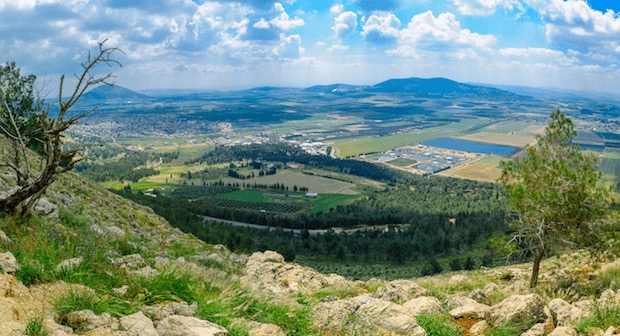
The battle would unfold in the Jezreel Valley: picture a landscape stretching from west to east, beginning at Mount Carmel and the Sea of Galilee, and reaching the Jordan River through the mountains of Gilboa, Hermon, and Tabor. It spans from south to north, from the mountains of Ephraim to those of Galilee. As the Israelites prepared for battle, Deborah and Barak ascended Mount Tabor, where the 10,000 Israelite soldiers faced the overwhelming might of Sisera’s 900 iron chariots. But God was with the Israelites. As the battle started, a miraculous storm unleashed heavy torrential rain that flooded the Kishon River, catching Sisera’s men off guard. The downpour rendered Sisera’s chariots useless, trapping the Canaanite army in thick, slippery mud. The mighty iron chariots rendered completely useless and forced to flee on foot. This gave the Israelites the upper hand, leading to the defeat of Sisera’s forces.
Sisera fled and sought refuge in the tent of Jael, a Kenite woman. While he slept, Jael killed him by driving a tent peg through his skull, fulfilling Deborah’s prophecy that Sisera’s death would be at the hands of a woman.
Deborah’s Song of Victory
In Chapter 5 of the Book of Judges, Deborah sings a victory song. In 31 verses, she sings praises to God for the triumph over the Canaanites. Far from being proud or boastful, Deborah’s song gives all the glory to God. She recognizes that it was not through her strength or leadership, but rather God’s strength that brought the victory. She expresses a desire that those who love God would shine brightly, like the sun in its full strength. It’s clear in her song, that Deborah’s humility and confidence came from her unwavering faith in God, not in her own abilities – a trait that she embodied during her time judging the people of Israel.
Deborah’s life teaches us that it is God who choses who He uses and who is ready. Even though she was a woman, living in a male driven world, God used her mightily and she had the respect of the people of Israel. In a time when women had few leadership roles, Deborah was an example of strength, wisdom, and obedience. She didn’t let her sex hold her back from fulfilling God’s calling on her life. Through her, we see that God can use anyone—regardless of sex or status—to accomplish His purposes if they are willing to listen to His call and trust in His power.
Emulating Deborah’s Leadership
Deborah’s leadership was not marked by arrogance or domination, but by wisdom, grace, and humility. Unlike the “bossy” or manipulative women in the Bible, such as Delilah or Jezebel, Deborah wisely used her place in God’s story and influenced and respectfully guided the important men in her life and the children of Israel toward God and righteous action. She was respected by the men around her, including Barak and the military leaders, who followed her lead.
Her example teaches us that God calls women to positions of influence, whether in their homes, churches, workplaces, or communities. By following her example of wisdom, faith, obedience, discretion, and courage, we too, man or woman, can become instruments of God’s will, influencing and collaborating with the people around us for good.
Questions for Reflection:
- How was Deborah a good leader? What qualities do we look for in leaders?
- How does Deborah’s leadership style differ from that of a “bossy” woman?
- What battles are we facing today, and how can we be victorious like Deborah?
Hebrews 11.32-34: 32 And what shall I more say? for the time would fail me to tell of Gedeon, and of Barak, and of Samson, and of Jephthae; of David also, and Samuel, and of the prophets: 33 Who through faith subdued kingdoms, wrought righteousness, obtained promises, stopped the mouths of lions. 34 Quenched the violence of fire, escaped the edge of the sword, out of weakness were made strong, waxed valiant in fight, turned to flight the armies of the aliens.
For Jael’s part of the story:
Part 1: https://jaelsjournal.blog/2022/04/05/jael-the-hospitable-warrior-part-1/
Part 2: https://jaelsjournal.blog/2022/06/20/jael-the-hospitable-warrior-part-2/
 Jael's Journal